

If you ever find yourself trapped in a blazing building, the stairwell may seem like the only way out. But in parts of East Asia, there’s another evacuation option that looks like it belongs in a Mission Impossible movie: the descending life line (DLL) or “완강기” in Korean.
Different countries call them different names, such as kankōki (緩降機) in Japanese and huǎn jiàng qì (缓降器) in Mandarin, but the core principles remain same. Just like the automatic safety ropes used in climbing, they gently lower the user to the ground at a controlled pace no matter their weight.
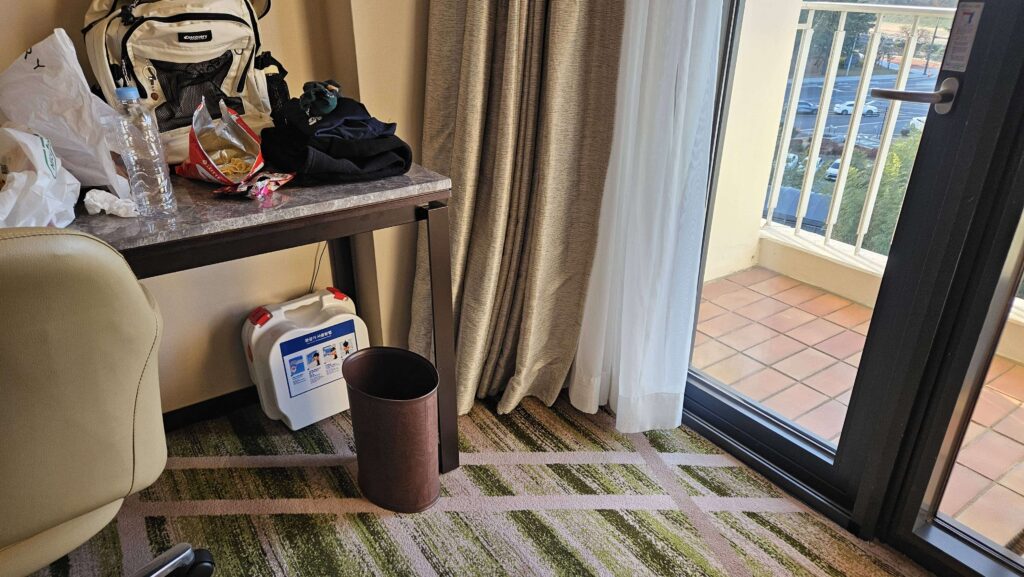
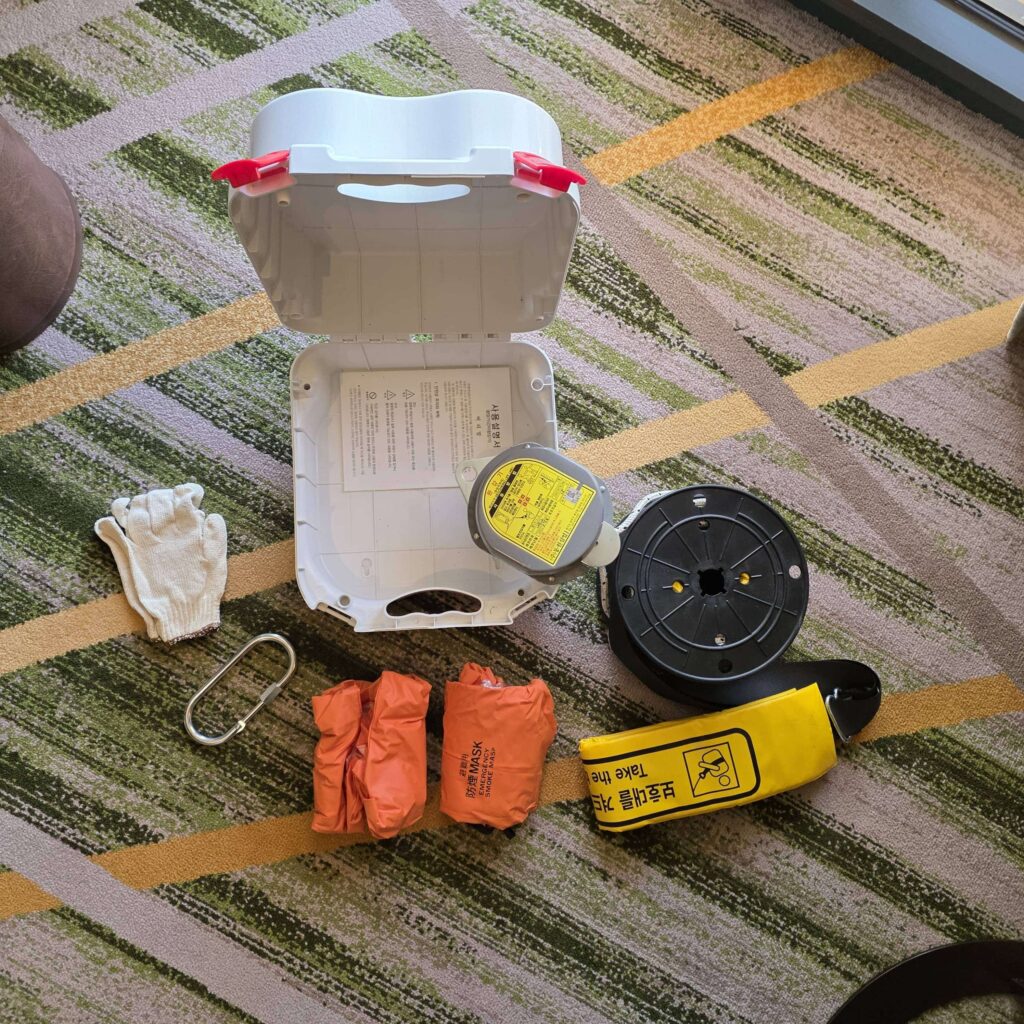
DLLs are stored in a marked container near windows, balconies, or rooftops. Inside, you’ll find the main unit—which includes the spool, regulator, and strap—plus a separate hook. Before use, attach the regulator securely to its support point (indicated with small red sign), which could be a fixed hook or a swivel arm. Then lower the spool outside, making sure the area below is clear. To put it on, slip the strap under your arms, tighten it until it’s snug, and then start your descent. As you go down, keep your hands (not your feet) pressed against the wall to avoid collisions.
Although the device has existed for decades, its adaptation did not become widespread until the 2000s, when regulations expanded to mandate DLLs in many types of buildings, most notably hotels and most modern apartments, where each unit/residence must have a DLL each. Many members of Gen X recall growing up without ever seeing one.
Nowadays, South Korean fire code generally requires floors 3 through 11 to have at least one DLL per floor. While the TCIS academic buildings are exempt because they have multiple evacuation routes, the TCIS dormitories do include DLLs.
Despite their lifesaving potential, awareness remains low. In one study, around 80% of Sejong and Daejeon residents reported not knowing whether their workplace or school has a DLL. DLLs can be hard to set up, especially in high-stress situations, and improper use has led to tragic accidents. When TCIS students and teachers were asked about the device, many indicated confusion, and some did not even recognize the device at all.
Former Dubai resident Eunwoo Cho ’27 noted how DLLs aren’t typical in Dubai, even though it would be useful “in countries where apartments are common.” He added that “most people would be too scared” to use one.
Such fear may not entirely be unjustified. Many DLLs suffer from poor maintenance, resulting in fraying ropes, damaged regulators, and loose support points. It is important to be aware of where DLLs are in your homes and schools, and ensure their maintenance.