

Sleep is undoubtedly the most important thing humans do on a daily basis. It is also the most neglected part of modern life, lack of which harms your quality of life. This is not an opinion of mine; it is a scientific fact with an abundance of scientific literature to back it up.
This article is broken down into parts: what sleep is, what controls sleep, why sleep exists and the functions of sleep, how sleep changes across a person’s lifespan, sleep and ADHD, modern society and sleep, and how to sleep.
What is sleep?
On an intuitive level, we all know what sleep is. We go unconscious when we are tired, and we (hopefully) wake up not feeling tired. Sleep is a powerful biological process that repairs the body, refreshes the brain, and keeps nearly every system in your body functioning properly.
Sleep is only achieved through natural processes. This means sleep cannot be achieved by artificial means. Sleep pills, anaesthesia, and any other artificial sedation do not count as sleep. A person may look like they are sleeping, but biologically, none of the essential benefits of sleep is being achieved through artificial sedation. In fact, the so-called “sleep” pills put you into a state that is similar to anaesthesia. They lead to increased risk of insomnia, heart disease and possibly dementia. In simpler terms, do not take sleep pills.
There are 4 stages of sleep: stage 1, stage 2, stage 3 (stages 1 to 3 are NREM sleep, or non-rapid eye movement sleep), and REM sleep (rapid eye movement sleep). Stage 1 is the lightest stage of sleep. During stage 1, your muscles relax, and you can easily wake up. In Stage 2, your breathing slows, body temperature drops, and makes up the largest portion of sleep. In stage 3, physical repair and growth occur, the immune system strengthens, and it is difficult to wake up from. During REM sleep, you dream.
REM sleep is particularly interesting because your brain becomes hyperactive. The brain recalls and reorganizes memory and the different areas of the brain communicate intensely. Dreaming occurs during REM sleep, which means your body becomes paralyzed because your brain is sending out motor signals, and you would get seriously injured every night if not for paralysis. One important thing to note is that REM sleep happens toward the end of your sleep – we’ll get to this in the “modern society and sleep” section.
What controls sleep?
Sleep is controlled by two things: the circadian rhythm and sleep pressure.
The circadian rhythm is a biological clock system that tells the body when to feel sleepy and when to feel awake. It is strongly influenced by exposure to light. It also controls the release of melatonin, a hormone that promotes sleep. It is the primary cause of jet lag, because it cannot shift fast enough to adapt to a new time zone. The fastest rate at which it can shift is around one hour per day, meaning that to shift to a time zone that is 7 hours faster, you would need 7 days.
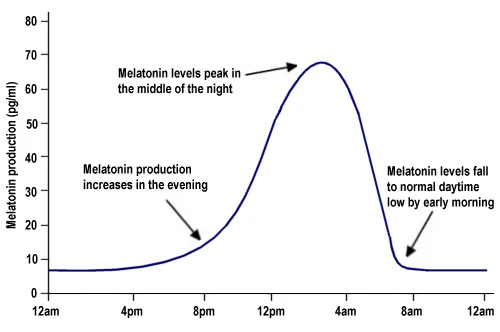
Sleep pressure is the buildup of adenosine in your body for the duration you remain awake. Adenosine binds to your adenosine receptors, and the more adenosine is built up, the more you feel sleepy. A good night’s sleep will reset the adenosine buildup in your body, causing you to feel fresh again. If you remain awake for a long period of time, adenosine will continue to build up until you finally sleep. This is how caffeine works. Caffeine blocks the adenosine receptors, causing you to feel more awake. However, it doesn’t clear the adenosine buildup, meaning when the effects of caffeine run out, you suddenly feel sleepy and experience a crash.
These two systems work together to influence when you feel sleepy or awake.
Why sleep exists, and the functions of sleep
Why does sleep exist? Sleeping, from an evolutionary perspective, may seem counterintuitive; you cannot gather food, reproduce, or defend yourself when you are sleeping. You are left completely vulnerable to predators, and you could be spending the time sleeping to gather food or reproduce. Surely, there is a reason it is a necessary part of nearly every animal’s life after millions of years of evolution. And there is; sleep serves multiple imperative functions for survival, not just for humans, but for other species too.
* Scientists do not currently know every function of sleep
Function 1: Brain & Cognitive
- One function of sleep is memory consolidation. Sleep is necessary for memorization, and a few nights of good sleep are needed to make a temporary memory permanent. NREM sleep is mostly responsible for stabilizing memories, while REM sleep is responsible for extracting patterns and relationships from the memories.
- Similar to memory, sleep is critical for skill acquisition; skills are stabilized and then processed during sleep.
- Sleep allows for prolonged focus. In fact, it is the strongest determinant of a person’s ability to focus. Without sufficient sleep, it is biologically impossible to focus, due to reduced activity in the prefrontal cortex and microsleeps (the brain repeatedly shutting down for small periods of time). It is not a well-known fact that chronic sleep deprivation has nearly identical effects as ADHD (More on this in the “sleep and ADHD” section).
- Sleep shortens reaction time, allowing you to react fast to outer stimulus.
- Sleep allows for better planning and decision-making.
- Sleep is the source of human creativity. Increasing creativity is one of the main functions of REM sleep. During REM sleep, the part of the brain that controls logic deactivates while the brain replays memories and finds patterns and relationships between them. Without REM sleep, creativity is significantly reduced.
- Sleep allows for better problem-solving, due to increased planning and decision-making skills coupled with increased creativity.
Function 2: Emotional & Psychological
- Sleep helps regulate emotions. The amygdala, a part of the brain that generates emotional reactions, becomes hyperactive with insufficient sleep, causing you to have more dramatic reactions to relatively small events.
- Sleep regulates stress. In the morning, cortisol (the primary stress hormone) levels are naturally high to wake you up. At night, they are naturally low to allow you to fall asleep. With insufficient sleep, cortisol levels remain high, and average cortisol levels rise as a result, causing you to feel more stressed.
- Sleep allows you to better resist temptations. Individuals with chronic sleep deprivation will find it harder to resist temptations because their brains are craving rewards.
- REM sleep sometimes helps with trauma. By replaying bad memories in dreams, it can help cure traumatic memories over time. However, if the memory is too traumatic, it often results in Post Traumatic Stress Disorder.
Function 3: Brain Maintenance
- Sleep removes metabolic waste and prevents toxic buildup in the brain, increasing long-term brain health and neural efficiency.
- Sleep removes toxic protein buildup in the brain that interferes with neural communication.
- Sleep carries out synaptic pruning. Synaptic pruning is the weakening of unimportant neural connections in the brain that were created during the day. This prevents overload and increases neural efficiency.
- Sleep carries out synaptic strengthening. This is the opposite of synaptic pruning; it strengthens useful or important neural connections in the brain.
- Sleep regulates neural plasticity, allowing you to learn and retain information.
Function 4: Physical Repair & Growth
- Growth hormones are released during NREM sleep, allowing for muscle repair and hypertrophy, tissue regeneration, bone remodeling and cellular repair. During the day, catabolic (breakdown) processes dominate, while during sleep, anabolic (building) processes dominate.
Function 5: Immune System
- During sleep, bone marrows increase production of immune cells, and communication between immune cells is made more efficient.
- Sleeping allows vaccination to be effective. Sleeping releases antibodies, and vaccines work by triggering the release of certain antibodies. With poor sleep, vaccination may have no effect.
- Disease-fighting is more effective during sleep, because more energy can be allocated to the immune system instead of movement and cognition.
Function 6: Cardiovascular & Metabolic Regulation
- Sleep helps regulate blood pressure. It does this by lowering blood pressure during sleep, reducing stress on the heart and artery walls.
- Sleep helps lower heart rate and strain.
- Sleep maintains insulin sensitivity, preventing the body from becoming insulin-resistant.
- Sleep increases glucose uptake in the brain, allowing for efficient neural processes.
- Sleep regulates appetite; poor sleep leads to increased appetite, and chronic sleep deprivation often leads to weight gain.
Function 7: Developmental Functions
- In infants, children, and teenagers, sleep drives physical and psychological maturation. Insufficient sleep in developing infants, children, and teenagers leads to mental and physical illnesses, lower intelligence, and lower learning capacity. Sleep is vital for development.
How does sleep change across a person’s lifespan?
Sleep is necessary throughout the entire duration of a person’s lifespan, but its duration and composition shift as a person ages.
0-2 years
Infants sleep 12 – 16+ hours per day. Their sleep is spread across day and night, and is composed mostly of REM sleep, because they are going through rapid brain development. In other words, the majority of an infant’s day is spent sleeping, and for good reason.
3-10 years
Children 3 – 10 years old typically sleep 9 – 12 hours per day. At this age, sleep becomes more stable, meaning most sleep happens during nighttime. The composition of sleep changes; REM sleep decreases gradually, and NREM sleep increases gradually. This is to support physical growth, learning, and memory consolidation.
11-18 years
Adolescents 11 – 18 years old should sleep 8 – 10 hours per day. I say should, because most get far less. An interesting phenomenon is that the circadian rhythm of teenagers shifts later, causing them to naturally fall asleep and wake later. We do not know why exactly this happens, but one theory suggests that it allows teenagers to develop independence by spending more time alone, while their parents are asleep.
19-64 years
Adults in this age range should sleep 7 – 9 hours per day. Adults experience a gradual decline in NREM as they age. Apart from this, their sleep is very stable and supports maintenance, not development.
65+ years
Elderly adults in this range should sleep 7 – 9 hours as well. However, most elders experience difficulty falling and remaining asleep, leading to fragmented sleep and less deep NREM sleep. As a consequence, many experiences decreased memory and impaired skill acquisition.
Sleep and ADHD
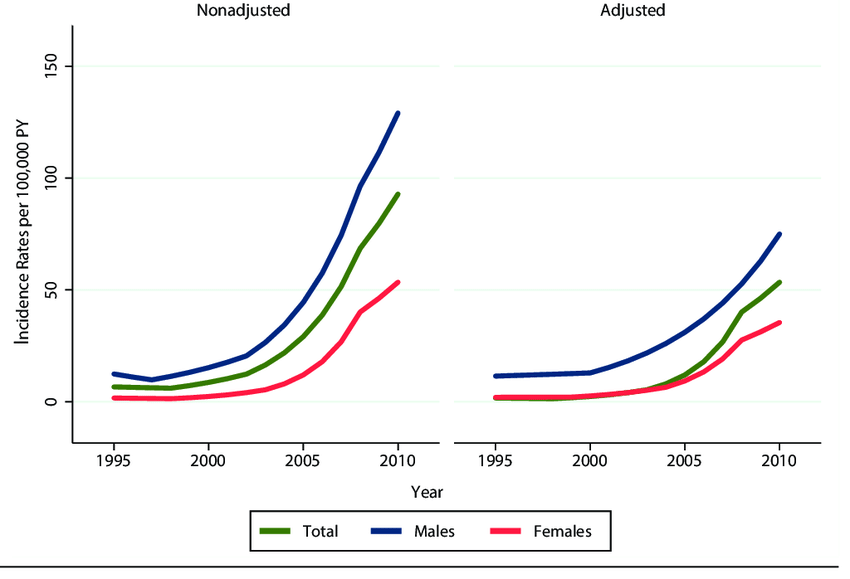
As seen in the graphs above, diagnosed ADHD rates have increased exponentially over the last century.
The symptoms of ADHD are as follows: difficulty sustaining focus, feeling restless, frequent careless mistakes, appearing not to listen when spoken to directly, poor organization, avoidance of tasks that require mental effort, and forgetfulness.
Similarly, the symptoms of sleep deprivation are as follows: difficulty sustaining focus, feeling restless (increased cortisol levels), frequent careless mistakes (poor decision-making), appearing not to listen when spoken to directly (microsleeps), poor organization (poor planning), avoidance of tasks that require mental effort (craving more rewards instead), and forgetfulness (decreased memory consolidation).
A part of the reason why diagnosed ADHD has become so much more prevalent may be due to misdiagnosis by doctors. It is difficult to distinguish between actual ADHD and sleep deprivation, especially when the affected individual is unaware of their sleep-deprived state.
The takeaway is, if you think you have ADHD or have been diagnosed with ADHD, ask yourself the question: Am I getting sufficient, quality sleep?
Modern Society and Sleep
Humans, as a species, are diurnal creatures, meaning we sleep once at night, with the movement of the sun. However, historically, some societies practiced biphasic sleeping, which means sleeping twice. They woke up in the middle of the night to do light activities such as reading or prayer before falling asleep again. There is no proven biological benefit of biphasic sleeping over monophasic sleeping, or monophasic sleeping over biphasic sleeping, however.
Furthermore, prior to the Industrial Revolution, getting sufficient sleep was not as difficult or as uncommon as it is in modern society. There were no long work hours, nine-to-five jobs, work/school demands, and more keeping us from getting sufficient sleep.
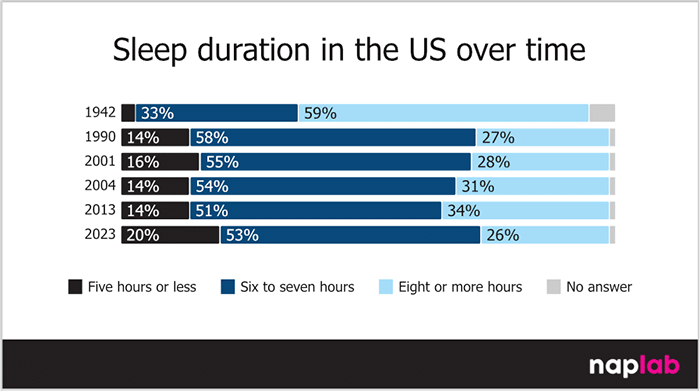
As seen in the graph above, average sleep duration has been declining over the last century: more people are sleep-deprived today than in the 20th century. 20% of Americans in 2023 slept five hours or less per day, and 53% of Americans in 2023 slept six to seven hours per day. Only 26% were sufficiently rested.
We use artificial light to light our homes, buildings, and streets after the sun sets. We also use it in electronic devices to clearly see the screens. Although it is incredibly convenient, it offsets our circadian rhythm to make us feel awake when we shouldn’t. Artificial light emits blue light, which suppresses melatonin. As discussed in the “What Controls Sleep?” section, melatonin is a hormone that promotes sleep; if melatonin is suppressed, sleep pressure is decreased. Before artificial light was invented, humans relied on the sun and fire for light. This meant that nights were much darker than they are today, and humans naturally fell asleep earlier. However, in modern society, artificial light is ubiquitous, and large cities are just as navigable at night as they are during the day. This chronically increases post-sunset exposure to blue light in the entire human species, causing us to fall asleep later and sleep less.
In addition to artificial light, we are experiencing a shift in work culture. In social media, and absurdly, in schools, a hardcore work culture is being promoted. This new work culture favors sacrificing sleep to work more, implying that the more sleep you sacrifice to work, the more successful you will be. This, from a scientific and practical point of view, is absolutely preposterous. As discussed in the above sections, sleep deprivation and proper function are mutually exclusive; humans cannot biologically function properly, let alone optimally, when sleep-deprived. There is, however, one niche exception to this fact: a small percentage of the population carries a gene that allows them to function properly with only six hours of sleep. But before you think you have this gene, you most likely don’t. It’s extremely rare, and only about 0.1% of the population (one in a thousand people) carry it. The practical takeaway is this: never sacrifice sleep to work or study more.
It is unfortunate to admit that most schools are contributing to sleep deprivation in developing children and teenagers around the world. There are multiple ways in which they do this, and it varies around the world. In the US, schools start early and end early, at around 7:30. Logically, this may be convenient because it allows schools to end earlier, and for adults with a healthy sleep schedule, it most likely is. But for developing teenagers, they are robbed of the REM sleep they need very much. As mentioned in the “How does sleep change across a person’s lifespan?” section, the circadian rhythm of teenagers naturally shifts later, causing them to fall asleep and wake up later. Furthermore, as mentioned in the “Why sleep exists, and the functions of sleep” section, REM sleep nourishes creativity, problem-solving skills, synaptic pruning, and efficient memory and learning. REM sleep also takes place towards the end of a night of sleep. As a result, teenagers miss out on REM sleep and overall sleep quality because they are forced to wake up earlier than they should; because of school start times, teenagers cannot develop or learn properly.
How to sleep
Sleeping isn’t just about duration. To ensure you are sufficiently rested, here are the things science says you should do to sleep sufficiently, not in any particular order:
- For adults, sleep at least 7 hours a day, every day. For teenagers, sleep at least 8 hours. This is probably the most well-known method of sleeping well. To sleep a certain amount, you need to take into account sleep efficiency. That is, the percentage of your time in bed in which you are asleep. You should adjust your time in bed according to your sleep efficiency. In other words, going to bed at 10 and waking up at 8 does not mean you slept 10 hours. An interesting fact is that if you are deprived of only an hour of sleep a day for seven consecutive days, you will suffer the same cognitive and physical effects of foregoing an entire night of sleep.
- Fall asleep and wake up at the same time every day. Sleep consistency is a huge determinant of sleep efficiency, because your circadian rhythm changes slowly. Work with your circadian rhythm to increase your sleep efficiency and quality.
- Avoid artificial light as much as possible after sunset. This means no bright lights; invest in dim yellow lamps that emit less blue light, and/or blue light blocking sunglasses. Don’t use devices one hour before bed, and if you must, turn the blue light filter on.
- Do not stress yourself before bedtime. This includes exercise, cognitive workload, thinking about all your problems in life, and anything that creates stress. Instead, do something relaxing, such as stretching or reading.
- Sleep alone. Sleeping with others will cause you and them to wake up more often, resulting in decreased sleep efficiency.
- Sleep in a cool room. Body temperature naturally drops during sleep, and a decrease in body temperature makes you sleepy. Ideally, it should be cold when not using a blanket, and just warm enough when using a blanket. If you are not cold when not using a blanket, it is not cold enough. We evolved to feel sleepy in colder temperatures because we are diurnal creatures.
- Sleep in a dark room. Any form of light emits blue light. Ideally, your room should be as close to pitch-dark as possible.
- Sleep in a quiet room. Noise wakes you up and makes sleep shallower; it is harder to fall asleep and stay asleep in a noisy room.
- Sleep in a comfortable bed. You should have a pillow that supports your posture, and a comfortable blanket and mattress.
- Avoid caffeine or any other stimulants at least 8 hours before bed. Caffeine has a half life of five hours, and remaining caffeine in the blood significantly affects sleep pressure.
- Do not drink beverages or eat at least 3 hours before bed. Digestion uses a large amount of energy and raises body temperature; the earlier you eat your last meal the better. But of course, drinking water is fine, as long as it is in moderate amounts, and will not cause you to wake up to use the toilet frequently.
- Avoid long naps. This disrupts your circadian rhythm and adenosine levels.
- Be healthy. Exercise, eat nutritious food and be happy. This increases sleep efficiency.