

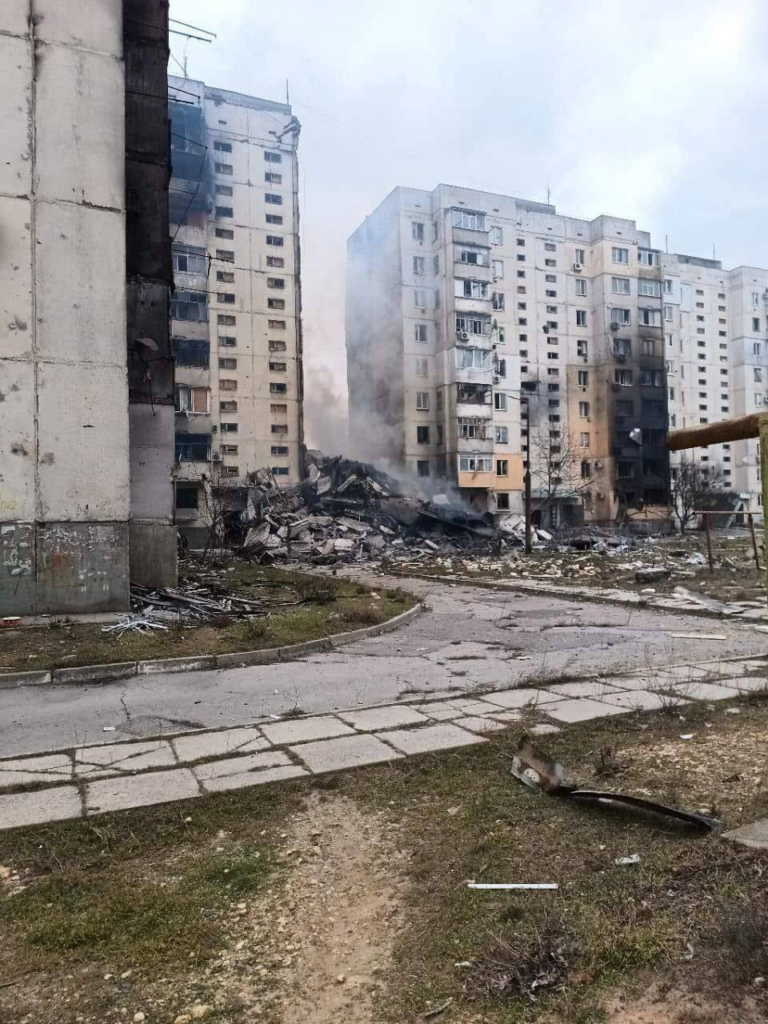
Around 2000 people are trapped in the Russian-occupied Ukrainian city of Oleshky. Among them are approximately 50 children. They are living without access to food, electricity, or water, while medical care is extremely limited due to a lack of medicine, and there is no safe or organized way for citizens to leave.
And this is happening right now.
Food and humanitarian aid deliveries to Oleshky stopped in late May, according to the UN Human Rights Monitoring Mission in Ukraine. By June, residents were surviving on preserved food and whatever limited supplies they could find, including weeds and grass.
At the same time, basic infrastructure has collapsed. Residents live without electricity and gas, relying on wood-burning stoves and increasingly scarce fuel. Medical services are barely functioning, while mines and drone attacks make movement around the city and attempts to leave are extremely dangerous (Human Rights Watch).
People cannot safely get out. Food and medicine cannot reliably get in. And among those waiting for help are children.
Oleshky is facing a humanitarian catastrophe that cannot be reduced to another statistic of the war. These are thousands of civilians who are still living in their homes, trying to find food, obtain medicine, and survive another day in a city cut off from the outside world.
Oleshky is a Ukrainian city in the Kherson region, on the left bank of the Dnipro River, directly across from Kherson. Before Russia’s full-scale invasion in February 2022, around 24,000 people lived there. Russian forces have occupied the city since February 2022 and by today there are only around 2,000 civilians remaining, according to Human Rights Watch).
Although Oleshky is only about nine kilometres from Kherson, reaching Ukrainian-controlled territory is extremely difficult. The destruction of bridges and other infrastructure, Russian checkpoints, landmines, and ongoing attacks have left civilians without a safe evacuation route (Ukrainska Pravda).
What does life look like inside?
The humanitarian crisis in Oleshky is visible in the most basic necessities of everyday life
FOOD. The last regular food delivery to Oleshky was reported on May 26, 2026. According to the UN Human Rights Monitoring Mission, residents had already been surviving on preserved food and limited deliveries before supplies stopped completely. The UN reported that the town’s last grocery store had ceased regular operations due to a lack of food (UN Human Rights Monitoring Mission in Ukraine).
ELECTRICITY & GAS. Former residents interviewed by Human Rights Watch reported that Oleshky has no electricity or gas. Many people have been forced to use wood-burning stoves, while fuel for generators has become increasingly scarce and expensive (Human Rights Watch).
WATER. The city also faces a severe shortage of drinking water. In March, Ukraine’s Human Rights Ombudsman described the situation as a “catastrophic shortage” of drinking water, while recent testimony from residents reports that people are afraid to leave their homes, even to collect water (Ukrainska Pravda).
MEDICINE & HEALTHCARE. Medical care has become extremely limited. The Oleshky hospital is operating on emergency generator power, while ambulances reportedly no longer regularly reach people’s homes. The UN reported that injured patients awaiting transfer to another hospital could not be evacuated, and one patient died while waiting (Human Rights Watch).
SAFETY. Even trying to obtain food, water, or medical care can be dangerous. Mines and drone attacks have made roads and movement around the city dangerous. On June 2, a vehicle convoy carrying food and humanitarian aid reportedly hit a mine at the entrance to Oleshky, killing one person and injuring three others (UN Human Rights Monitoring Mission in Ukraine).
These are not distant consequences of war. They are the disappearance of the things people need simply to live: food, water, electricity, medicine, and a safe way to reach them.
And there are still children in Oleshky.
Around 50 children are trapped in Oleshky. For these children, the war is not something happening somewhere else. It is the environment in which they are growing up — without reliable access to food, water, electricity, or medical care, and without a safe way to leave.
When aid has to come by drone
With conventional humanitarian access severely restricted, Ukraine has resorted to an extraordinary method: drones. On September 28, Ukrainian forces delivered around four tons of food and medical supplies to approximately 100 locations in Oleshky. Ukrainian officials say Russian forces have blocked humanitarian deliveries and rejected proposals for civilian evacuations. Russia has disputed Ukrainian accounts while acknowledging that Oleshky is facing critical shortages and saying that Russian forces are working to address them (Reuters).
Leaving Oleshky
There is no normal, safe evacuation route out of the city. People who have escaped Oleshky said that they had to pass through Russian military checkpoints, while mines and ongoing attacks made the journey dangerous. Human Rights Watch found no organized evacuation system for civilians who are elderly, sick, wounded, or otherwise unable to leave on their own.
In June 2024, a woman escaped occupied Oleshky on foot and reached the destroyed Antonovsky Bridge, hoping to cross toward Ukrainian-controlled territory. She discovered that the bridge was impassable, but then noticed a Ukrainian drone overhead. She showed the drone operator her Ukrainian passport. The drone then guided her toward Ukrainian positions, where Ukrainian soldiers were able to evacuate her by boat (ТСН.ua).
Her story shows just how dangerous leaving Oleshky can be: even after making it out of the city, there was still no functioning bridge, no normal evacuation route, and no certainty that she would reach safety.
For the people still in Oleshky, the crisis is not over. Without reliable access to food, water, medicine, electricity, and safe evacuation, conditions can become even more dangerous, especially for children, older people, and those who need medical care. On September 25, the Council of Europe Commissioner for Human Rights called for unhindered humanitarian access to Oleshky and the safe evacuation of civilians who want to leave (Council of Europe).
Oleshky is not an abandoned city. People are still there. Children are still there. They are waiting for food, medicine, water, and a way to safety. Their situation should not disappear from the world’s attention simply because the city is difficult to reach.
Eyes on Oleshky.
Editor’s update: As of November 2026, a ceasefire is now in place to evacuate residents!