

This article was originally published on the KISPA Journal.
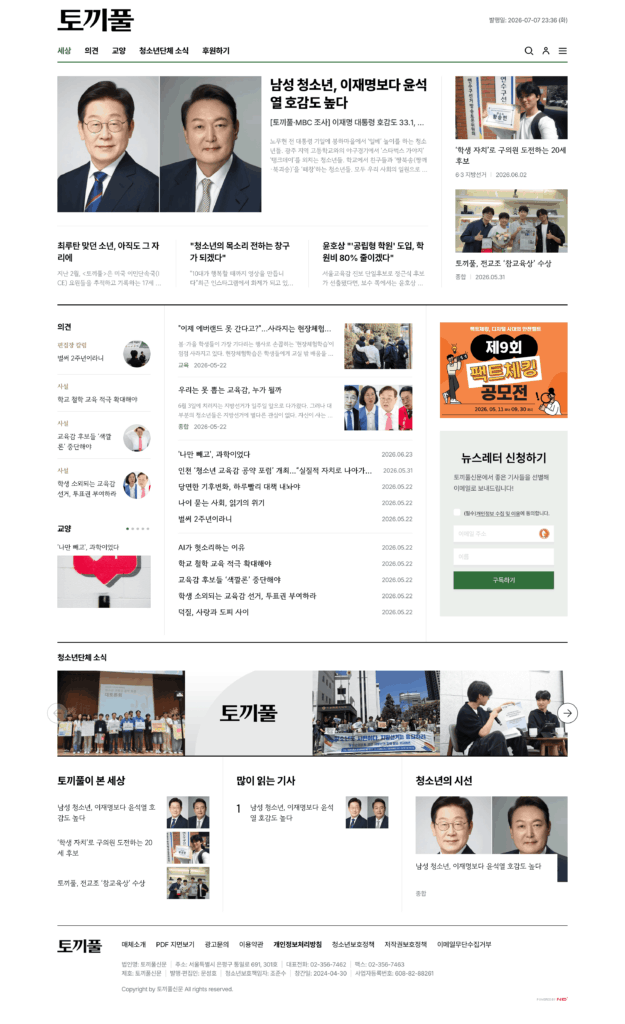
Tokipul (토끼풀) began as just another middle school newspaper club. Now, the Korean-language paper is fully independent, powered by its team of 32 students across four local schools.
Since April 2024, they have been publishing monthly and distributing 1,000 copies to each of the four schools and its donors.
From investigating far-right extremism in Roblox to interviewing Education deputies, their work doesn’t stop from their award-winning journalism however. From organizing press conferences to being interviewed in major news outlets, they are advocates for youth rights and free speech.
KISPA journalists Sean K. and Heeseo H. met with the paper’s editor-in-chief Moon Seong-ho (문성호) to discuss their work and challenges they face.
Editor’s note: all quotations are in their translated form.
How does it work?
Tokipul is a newsroom proper. Reporters work across several teams, including two social-affairs teams and a culture team. Before an article is written, reporters submit a topic for review. Team leaders and editors approve the proposed subject. Once a reporter completes an article, it goes through another round of editing before publication.
Notably, the paper only accepts students up to 11th grade. Seniors would be too busy with the Korean university entrance exam, or suneung, and too disconnected with the youngest writers, Moon says.
Its name, literally meaning ‘clover’, came from an item in Legend of Zelda.
The Myth of Neutrality
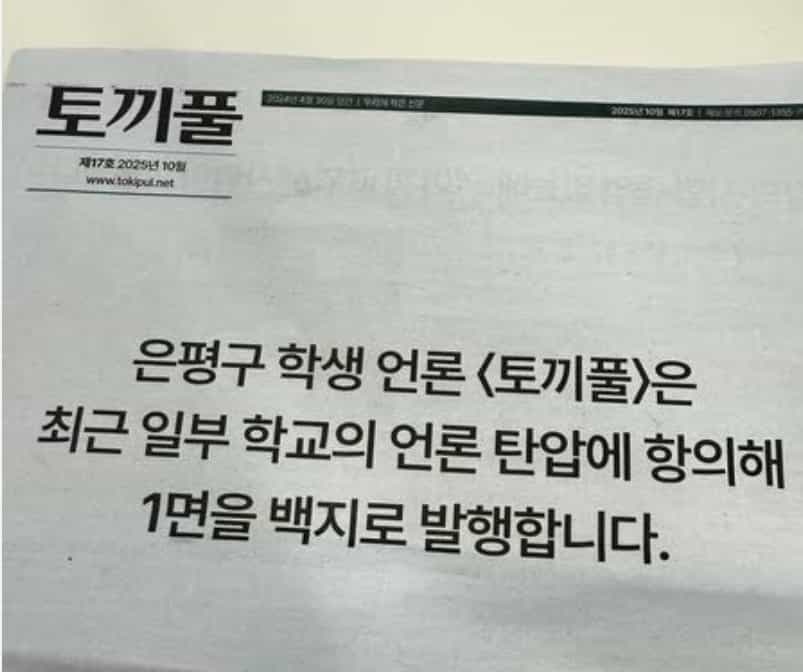
Perhaps the most contentious idea in Tokipul’s newsroom is “neutrality.”
The editors do not believe that journalism must always position itself halfway between opposing political forces. Moon puts it bluntly: “Asking for neutrality is an insult.”
Moon argues that such requests by schools enables institutional oppression under the guise of “objectivity”. True objectivity is impossible, Moon says.
The paper therefore does not try to balance progressive and conservative positions simply for the sake of appearing politically neutral. Instead, it says it is willing to criticize anyone when it believes students’ rights are being restricted.
Advocacy
Moon is no stranger to interviews. During our conversation, he answered all of our questions with practiced ease, and efficiently directed us to the Internet for factual questions.
Yet he is also critical of how mainstream media covers young activists. He says young people are often portrayed as “commendable teenagers,” turning their activism into an inspirational story rather than treating them on equal terms with adults.
Still, he sees media attention as useful. If being portrayed as “commendable teenagers” brings attention to an issue, Tokipul is willing to work with that.
Tokipul has organized multiple press conferences, including one in front of the Supreme Court. He is careful to not call it a “protest” — it’s illegal to protest in front of the Supreme Court.
Under current law, minors cannot register as publishers or editors of periodicals, leaving a publication run entirely by minors unable to obtain the same legal status and protection as a conventional registered news organization.
Money is another issue entirely.
Tokipul relies on donations to keep publishing, but the Donation Collection and Use Act (기부금품법) requires registration for collecting at least 10 million won in donations within the relevant period, while minors cannot register as donation collectors. The law also imposes significant requirements on how registered donations are collected and used. This law is the greatest threat to student free speech, Moon says.
To counter those bureaucratic blocks, Tokipul has to weigh the risks of raising a formal constitutional petition versus patiently waiting for legislation to change—which may never happen. It’s a dilemma that Tokipul faces every day.
What is hardest about being a student newspaper?
Running a newspaper is difficult enough. Running one with constantly changing staff as they graduate makes it harder.
But one of its biggest challenges, Moon says, is ultimately reaching readers.
Tokipul is looking for ways to attract readers, both adults and students alike. Moon fears that the declining interest in reading makes long-form journalism harder to sell to younger audiences.
Yet they are unwavering in their journalistic integrity. When asked about expanding to short form content, Moon says the proposal has been considered and rejected—short form content cannot contain all nuances of story. Instead they are planning on a documentary.
Looking forward
Two years after beginning as a school club, Tokipul is no longer simply a newspaper project. It is a newsroom, an advocacy organization, and an experiment in what youth journalism can look like when students control the publication themselves.
Student rights remain at the center of its work, including debates over smartphone restrictions and policies intended to protect young people. But Tokipul says it will also continue scrutinizing groups that it might otherwise politically sympathize with when their actions restrict youth rights.
And Moon is determined to prove that student-led journalism is no less legitimate than those led by adults.